
Here’s my latest on IIHF.com.
The reasons may be deep-rooted in the culture, and the enforcers may also be just a fad. But Finns are a tough people who respect hard work, perseverance, and raw power. The weak will fall on the road of life, a Finnish proverb goes.
Read it here, or continue reading below.
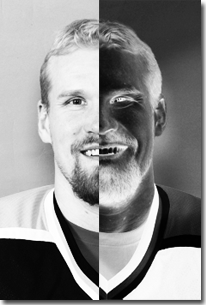
Part of the game, or not
With fighting, Finland is either ahead of the curve – or way behind.
HELSINKI – The Helsinki teams, Jokerit and HIFK, played a pre-season derby as part of the Nordic Trophy. The Helsinki derbies have almost always been heated battles. Maybe not splitting families along the team colour lines – not since the Kapanen brothers, Hannu (HIFK) and Jari (Jokerit), had a big brawl in the 1970s – but big events anyhow.
This week, though, there were no fights – a fact that seemed to disappoint at least one of the players.
“We had a script but it didn’t happen,” said Sami Helenius, Jokerit, after the game, according to Finnish Iltalehti.
“I was offered some work during the warm-up, but I told him that let’s play a little first. And then we only were on the ice at the same time once,” he said.
The “work” was “fighting”. And “he” was HIFK’s Kip Brennan, a Canadian winger, with 27 goals to his credit – since 2001. He’s played in 61 games in the NHL, with 222 penalty minutes in them. In his best season, 2004-05, he played 48 games in the AHL, scored seven goals and sat 267 minutes in the sin bin.
Helenius, the working man, racked up 231 penalty minutes in 68 games in the AHL in 1996, and broke 200 minutes two other times in his career. When he left Finland in 1994 and reported at the Calgary Flames training camp, he was a lanky kid with two seasons in the SM-Liiga under his belt. In the 38 games, he had got 46 penalty minutes, none of them a fighting major.
Ten years later, he returned to SM-Liiga and is now its undisputed heavyweight king – and a trendsetter.
One of the first designated policemen in the Finnish league, Helenius is now the yardstick against which everybody else gets measured. And against which others, eager to overthrow him, want to measure themselves.
In the past four seasons, SM-Liiga has seen players like Ryan Vandenbussche, Matt Nickerson, Kristian Kudroc, Mike Siklenka, Semir Ben-Amor, Jonne Virtanen, and Patrik Lostedt create havoc, and engage in fights like never before.
“I’m not sure it’s a real trend,” says Team Finland head coach Jukka Jalonen. “I think it’s mostly a Helsinki phenomenon, not every team has a dedicated player for fighting,” he says.
On the other hand, many teams do. According to Jukka Suutari, an expert on enforcers, or fighters, and author of Sami Helenius’s biography “The Seventh Defenceman”, about six or seven teams in the Finnish SM-Liiga have a player whose role it is to be the designated enforcer.
“For sure, five teams have a tough-guy on their roster, and another one or two have players who don’t mind doing the dirty work,” he says. That would make it about half the league. And who knows, half may be the tipping point, and soon having an enforcer on the roster is just a fact of life.
In 2007-08, the Finnish league dealt 27 games in suspensions to players for fighting. All in all, players got 58 games in suspension. Half of them were for fisticuffs. In other words, and on average, somebody was suspended for fighting for every two full rounds of games. (Lostedt already got himself a two-game suspension this pre-season after having thrown his gloves right after a faceoff, and provoking a fight that turned into a big brawl. In his four years in the SM-Liiga, Lostedt has played 125 games including the playoffs, collecting 3+2=5 points, and 332 penalty minutes.)
Suutari does see a trend. And he sees something else.
While fighting – especially the fisticuffs that seem to be set up in advance – often gets the player an additional suspension in SM-Liiga, Suutari think that fighting is practically an accepted part of the league culture.
“When Helenius returned to SM-Liiga in 2003-04, and he’d get ready to fight, he’d throw his helmet and gloves, but the linesmen would always rush in and break the fight right there. Today, the linesmen wait until the players are done with their fight, which to me, says that the referees have got new instructions for what to do with fights,” he says.
Suutari is currently the player coordinator of KooKoo Kouvola, a team in Mestis, the Finnish second-tier league, and yes, he says they have a player who can do the fighting, should the need arise.
“Although, you don’t really need that on this level,” he says.
While both Jalonen and Suutari may be right – three years is a short time to see a trend – they both think that SM-Liiga is one of the most physical, if not the most physical of the top European leagues.
“Maybe there are more fights in the SM-Liiga than other top European leagues,” says Jalonen.
“The Finnish league is probably more physical in every way, and that’s one of the defining specifics of Finnish hockey. Even with Team Finland, we can play a physical game and it hurts to meet us. Finland just may be the European national team that plays the most physical hockey, it’s just the way we are,” he adds.
The reasons may be deep-rooted in the culture, and the enforcers may also be just a fad. But Finns are a tough people who respect hard work, perseverance, and raw power. The weak will fall on the road of life, a Finnish proverb goes.
Maybe that’s why the top two songs in the Finnish iTunes store are by Metallica.
SM-Liiga kicks off this week, and on Thursday, HIFK will take on Jokerit again.
Maybe a hockey game will break out.